
This page is an unofficial translation of the current version of the law. There is no official English version, so this text is provided to make the Armenian traffic rules readable. The drawings come from the annexes to the decision itself. Source: Government of Armenia Decision No. 955-N of 28 June 2007
Road Signs (Form No. 1)
1. Warning Signs
Warning signs inform drivers of an approach to a dangerous section of road, movement along which (passage through which) requires taking measures appropriate to the situation. They include
1.1 "Railway crossing with barrier"

1.2 "Railway crossing without barrier"

1.3.1 "Single-track railway"

designation of a railway crossing without a barrier: 1.3.1 — with one track, 1.3.2 — with two or more tracks
1.3.2 "Multi-track railway"

designation of a railway crossing without a barrier: 1.3.1 — with one track, 1.3.2 — with two or more tracks
1.4.1 "Approach to a railway crossing"

an additional warning of an approach to a railway crossing outside built-up areas
1.4.2 "Approach to a railway crossing"

an additional warning of an approach to a railway crossing outside built-up areas
1.4.3 "Approach to a railway crossing"

an additional warning of an approach to a railway crossing outside built-up areas
1.4.4 "Approach to a railway crossing"

an additional warning of an approach to a railway crossing outside built-up areas
1.4.5 "Approach to a railway crossing"

an additional warning of an approach to a railway crossing outside built-up areas
1.4.6 "Approach to a railway crossing"

an additional warning of an approach to a railway crossing outside built-up areas
1.5 "Intersection with a tram line"

1.6 "Intersection of roads of equal importance"

1.7 "Roundabout intersection"

1.8 "Traffic signals"

an intersection, pedestrian crossing, or section of road where traffic is regulated by a traffic signal
1.9 "Drawbridge"

a drawbridge or ferry crossing
1.10 "Road leading onto an embankment"

exit onto an embankment or shore
1.11.1 "Dangerous bend"

a curve of small radius or with limited visibility: 1.11.1 — to the right, 1.11.2 — to the left
1.11.2 "Dangerous bend"

a curve of small radius or with limited visibility: 1.11.1 — to the right, 1.11.2 — to the left
1.12.1 "Dangerous bends"

a section of road with dangerous bends: 1.12.1 — first bend to the right, 1.12.2 — first bend to the left
1.12.2 "Dangerous bends"

a section of road with dangerous bends: 1.12.1 — first bend to the right, 1.12.2 — first bend to the left
1.13 "Steep descent"

1.14 "Steep ascent"

1.15 "Slippery road"

a section of road with an increased slipperiness of the carriageway
1.16 "Uneven road"

a section of road with surface irregularities (waviness, potholes, rough joints with bridges, etc.)
1.17 "Artificial bump"

a section of road with an artificial bump (bumps) intended to forcibly reduce speed
1.18 "Loose gravel"

a section of road where gravel, stone chips, etc. may be thrown up from under the wheels of vehicles
1.19 "Dangerous shoulder"

a section of road where driving onto the shoulder is dangerous
1.20.1 "Road narrows"

1.20.1 — narrows on both sides, 1.20.2 — on the right, 1.20.3 — on the left
1.20.2 "Road narrows"

1.20.1 — narrows on both sides, 1.20.2 — on the right, 1.20.3 — on the left
1.20.3 "Road narrows"

1.20.1 — narrows on both sides, 1.20.2 — on the right, 1.20.3 — on the left
1.21 "Two-way traffic"

the beginning of a section of road (carriageway) with oncoming traffic
1.22 "Pedestrian crossing"

A pedestrian crossing indicated by signs 5.19.1 and 5.19.2 "Pedestrian crossing" and (or) markings 1.14.1–1.14.2.
1.23 "Children"

a section of road running near children's institutions (schools, kindergartens, etc.), on the carriageway of which children may appear
1.24 "Intersection with a cycle path"

1.25 "Road works"

1.26 "Cattle crossing"

1.27 "Wild animals"

1.28 "Falling rocks"

a section of road where rockfalls, landslides, and falling stones are possible
1.29 "Side wind"

1.30 "Low-flying aircraft"

1.31 "Tunnel"

a tunnel with no artificial lighting, or a tunnel with limited visibility of the entrance portal
1.32 "Traffic congestion"

a section of road where a traffic jam has formed
1.33 "Other dangers"

a section of road on which there are hazards not covered by the warning signs listed above
1.34.1 "Direction of the bend"

the direction of travel on a curve of small radius with limited visibility; the direction for bypassing a section of road under repair
1.34.2 "Direction of the bend"

the direction of travel on a curve of small radius with limited visibility; the direction for bypassing a section of road under repair
1.34.3 "Direction of the bend"

the directions of travel at a T-junction or a fork in the road; the directions for bypassing a section of road under repair
1.35 "Intersection section"

indicates an approach to an intersection whose section is delineated by marking 1.26 and entry onto which is prohibited if a traffic jam has formed ahead in the direction of travel that would force the driver to stop, creating an obstacle to the movement of vehicles in the transverse direction along the road being crossed, except in the cases of turning right or left established by these Rules
Note Signs 1.1, 1.2, and 1.5–1.33 are installed before the start of the dangerous section: outside built-up areas — at a distance of 150–300 m, within built-up areas — at a distance of 50–100 m. If necessary, the signs may be installed at a different distance. In this case, the distance is indicated on plate 8.1.1 "Distance to the object."
Note Signs 1.1, 1.2, 1.9, 1.10, 1.23, and 1.25 are repeated outside built-up areas. The second (repeated) sign is installed at a distance of at least 50 m from the start of the dangerous section. Signs 1.23 and 1.25 are also repeated within built-up areas — directly before the dangerous section.
Note Signs 1.13 and 1.14 may be installed without plate 8.1.1 "Distance to the object," directly before the descent or ascent, if the descents and ascents follow one another.
Note When short-term works are carried out on the carriageway, sign 1.25 may be installed without plate 8.1.1 "Distance to the object," at a distance of 10–15 m from the place where the works are being carried out.
Note Sign 1.32 is used as a temporary sign or on signs with a changeable display — before an intersection from which it is possible to bypass the section of road where the traffic jam has formed.
Note Sign 1.35 is installed at the boundary of the intersection. If at complex intersections it is not possible to install the road sign at the boundary of the intersection, it is installed at a distance of no more than 30 m from the boundary of the intersection.
2. Priority Signs
Priority signs establish the order of passage through intersections, crossings of carriageways, or narrow sections of roads. They include
2.1 "Main road"

a road on which priority of passage through unregulated intersections is granted
2.2 "End of main road"

2.3.1 "Intersection with a secondary road"

2.3.2 "Junction of a secondary road"

2.3.2, 2.3.4, 2.3.6 — junction on the right; 2.3.3, 2.3.5, 2.3.7 — junction on the left
2.3.3 "Junction of a secondary road"

2.3.2, 2.3.4, 2.3.6 — junction on the right; 2.3.3, 2.3.5, 2.3.7 — junction on the left
2.3.4 "Junction of a secondary road"

2.3.2, 2.3.4, 2.3.6 — junction on the right; 2.3.3, 2.3.5, 2.3.7 — junction on the left
2.3.5 "Junction of a secondary road"

2.3.2, 2.3.4, 2.3.6 — junction on the right; 2.3.3, 2.3.5, 2.3.7 — junction on the left
2.3.6 "Junction of a secondary road"

2.3.2, 2.3.4, 2.3.6 — junction on the right; 2.3.3, 2.3.5, 2.3.7 — junction on the left
2.3.7 "Junction of a secondary road"

2.3.2, 2.3.4, 2.3.6 — junction on the right; 2.3.3, 2.3.5, 2.3.7 — junction on the left
2.3.8 "Junctions of secondary roads"
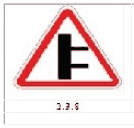
2.3.8 — junctions on the right, 2.3.10 — junctions on the left, 2.3.9 — junction on the right, then on the left, 2.3.11 — junction on the left, then on the right
2.3.9 "Junctions of secondary roads"
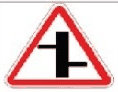
2.3.8 — junctions on the right, 2.3.10 — junctions on the left, 2.3.9 — junction on the right, then on the left, 2.3.11 — junction on the left, then on the right
2.3.10 "Junctions of secondary roads"
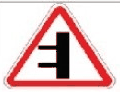
2.3.8 — junctions on the right, 2.3.10 — junctions on the left, 2.3.9 — junction on the right, then on the left, 2.3.11 — junction on the left, then on the right
2.3.11 "Junctions of secondary roads"
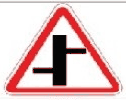
2.3.8 — junctions on the right, 2.3.10 — junctions on the left, 2.3.9 — junction on the right, then on the left, 2.3.11 — junction on the left, then on the right
2.4 "Give way"

The driver must give way to vehicles travelling on the intersecting road, or, when plate 8.13 "Direction of the main road" is present, to vehicles travelling on the main road.
2.5 "No entry without stopping"

Proceeding without stopping before the stop line, or, in its absence, before the edge of the intersecting carriageway, is prohibited. The driver must give way to vehicles travelling on the intersecting road, or, when plate 8.13 "Direction of the main road" is present, to vehicles travelling on the main road. If sign 2.5 is installed before a railway crossing or a quarantine checkpoint, the driver must stop before the stop line, and in its absence — before the sign.
2.6 "Priority for oncoming traffic"

entry onto a narrow section of road is prohibited if it may impede oncoming traffic. The driver must give way to vehicles approaching the narrow section from the opposite direction
2.7 "Priority over oncoming traffic"

a narrow section of road on which, when travelling, the driver has priority over oncoming vehicles
3. Prohibitory Signs
Prohibitory signs introduce or cancel certain traffic restrictions. They include
3.1 "No entry"

entry of vehicles in this direction is prohibited
3.2 "No traffic"

the movement of all vehicles is prohibited
3.3 "No motor vehicles"

3.4 "No goods vehicles"

the movement of goods vehicles and vehicle combinations with a permissible maximum mass exceeding 3.5 tonnes (if no mass is indicated on the sign) or exceeding the mass indicated on the sign, as well as tractors and self-propelled machines, is prohibited
3.5 "No motorcycles"

3.6 "No tractors"

the movement of tractors and self-propelled machines is prohibited
3.7 "No trailers"

the movement of goods vehicles and tractors with a trailer of any type, as well as the towing of motor vehicles, is prohibited
3.8 "No animal-drawn vehicles"

the movement of animal-drawn vehicles (sleighs), riding or pack animals, and the driving of livestock, is prohibited
3.9 "No bicycles"

the movement of mopeds and bicycles is prohibited
3.10 "No pedestrians"

3.11 "Mass limit"

the movement of vehicles (including road trains) whose total actual mass is greater than that indicated on the sign is prohibited
3.12 "Axle load limit"

the movement of vehicles for which the load on any axle is greater than that indicated on the sign is prohibited
3.13 "Height limit"

the movement of vehicles whose overall height (with or without load) is greater than that indicated on the sign is prohibited
3.14 "Width limit"

the movement of vehicles whose overall width (with or without load) is greater than that indicated on the sign is prohibited
3.15 "Length limit"

the movement of vehicles (including road trains) whose overall length (with or without load) is greater than that indicated on the sign is prohibited
3.16 "Minimum distance limit"

the movement of vehicles is prohibited if the distance between them is less than that indicated on the sign
3.17.1 "Customs"

passage past the customs point without stopping is prohibited
3.17.2 "Danger"

further movement of all vehicles is prohibited due to a road traffic accident, fire, breakdown, or other danger, with the exception of police vehicles, ambulances, rescue services, and other services that have arrived to eliminate the danger; movement may be continued only after permission has been obtained
3.17.3 "Inspection"

passage through the checkpoint without stopping is prohibited
3.18.1 "No right turn"

3.18.2 "No left turn"

3.19 "No U-turn"

3.20 "No overtaking"

overtaking by all vehicles is prohibited. It is permitted to overtake slow-moving vehicles, animal-drawn vehicles, two-wheeled motorcycles without a sidecar, mopeds, and bicycles
3.21 "End of the no-overtaking zone"

3.22 "No overtaking by goods vehicles"

overtaking by all vehicles is prohibited, except for motorcycles, passenger cars, buses, and goods vehicles with a permissible maximum mass of up to 3.5 tonnes
3.23 "End of the no-overtaking zone for goods vehicles"

3.24 "Maximum speed limit"

movement at a speed (km/h) exceeding that indicated on the sign is prohibited
3.25 "End of the maximum speed limit zone"

3.26 "No use of audible signals"

the use of audible signals is prohibited, except when a signal is given to prevent a road traffic accident
3.27 "No stopping"

stopping and parking of vehicles is prohibited
3.28 "No parking"

parking of vehicles is prohibited
3.29 "No parking on odd-numbered days of the month"

3.30 "No parking on even-numbered days of the month"

When signs 3.29 and 3.30 are applied simultaneously, vehicles are moved from one side of the road to the other during the period from 19:00 to 21:00
3.31 "End of all restrictions zone"

denotes the simultaneous end of the zones of effect of several of signs 3.16, 3.20, 3.22, 3.24, and 3.26–3.30
3.32 "No vehicles carrying dangerous goods"

the movement of vehicles fitted with the "Dangerous goods" identification sign is prohibited
3.33 "No vehicles carrying explosive and flammable goods"

the movement of vehicles fitted with the "Dangerous goods" identification sign and intended for the carriage of dangerous goods of classes 1, 2.2–2.4, 3.1, 3.2, and 5.2 (according to the standard) is prohibited
Note Signs 3.2–3.9, 3.32, and 3.33 prohibit the movement of the corresponding types of vehicles in both directions.
Note The effect of the following signs does not extend to:
Note 3.1–3.3, 3.18.1, 3.18.2 and 3.19 — public transport vehicles;
Note 3.2–3.8 — taxi cars; vehicles carrying out road construction, repair, maintenance or cleaning, servicing or repairing technical traffic-control equipment, or loading and transporting broken-down, accident-damaged or other vehicles; special postal-service vehicles bearing colour schemes; vehicles serving premises within the signed area, and vehicles belonging to or serving people who live or work in that area. In these cases, vehicles must enter and leave the signed area at the intersection nearest to the premises;
Note 3.2, 3.3 and 3.28–3.30 — vehicles driven by people with Group I or II disabilities, or with profound or severe limitations in functioning, and vehicles transporting such people or a child with disability status;
Note 3.28–3.30 — special postal-service vehicles bearing colour schemes, and taxi cars with an operating taximeter.
Note The effect of the following signs extends:
Note 3.10 and 3.27–3.30 — only to the side of the road on which they are installed;
Note 3.16, 3.20, 3.22, 3.24 and 3.26–3.30 — from the place where the sign is installed to the nearest intersection beyond it, or, in a built-up area with no intersection, to the end of the built-up area. Their effect is not interrupted at U-turn locations, gaps in the dividing strip, exits from areas adjoining the road, or intersections or junctions with field, forest or other secondary roads where no corresponding signs are installed before those roads;
Note 3.18.1 and 3.18.2 — to the crossing of carriageways before which the sign is installed;
Note 3.24, installed before a built-up area indicated by signs 5.23.1 or 5.23.2 — to sign 5.23.1 or 5.23.2 "Beginning of a built-up area".
Note The zone of effect of the signs may be reduced:
Note for signs 3.16 and 3.26 — by using plate 8.2.1 "Zone of effect";
Note for signs 3.20, 3.22 and 3.24 — by installing signs 3.21, 3.23 and 3.25 respectively at the end of their zone of effect, or by using plate 8.2.1 "Zone of effect";
Note for sign 3.24 — by installing the same sign with a different maximum speed;
Note for signs 3.27–3.30 — by using plate 8.2.2 "Zone of effect", or by repeating the corresponding sign 3.27–3.30 at the end of its zone of effect together with plate 8.2.3 "Zone of effect".
Note Sign 3.27 may be used together with marking 1.4, and sign 3.28 — with marking 1.10, in which case the zone of effect of the signs is determined by the length of the marking.
4. Mandatory Signs
Mandatory signs indicate the permitted directions of travel, the minimum speed, and also prescribe directions of movement for pedestrians and drivers of certain vehicles. They include
4.1.1 "Go straight"

movement is permitted only in the directions indicated on the signs by arrows. Signs permitting a left turn also permit a U-turn (signs 4.1.1–4.1.6 may be used in the form of arrows reflecting the configuration of the directions of travel at the given crossing).
4.1.2 "Turn right"

movement is permitted only in the directions indicated on the signs by arrows. Signs permitting a left turn also permit a U-turn (signs 4.1.1–4.1.6 may be used in the form of arrows reflecting the configuration of the directions of travel at the given crossing).
4.1.3 "Turn left"

movement is permitted only in the directions indicated on the signs by arrows. Signs permitting a left turn also permit a U-turn (signs 4.1.1–4.1.6 may be used in the form of arrows reflecting the configuration of the directions of travel at the given crossing).
4.1.4 "Go straight or turn right"

movement is permitted only in the directions indicated on the signs by arrows. Signs permitting a left turn also permit a U-turn (signs 4.1.1–4.1.6 may be used in the form of arrows reflecting the configuration of the directions of travel at the given crossing).
4.1.5 "Go straight or turn left"

movement is permitted only in the directions indicated on the signs by arrows. Signs permitting a left turn also permit a U-turn (signs 4.1.1–4.1.6 may be used in the form of arrows reflecting the configuration of the directions of travel at the given crossing).
4.1.6 "Turn right or left"

movement is permitted only in the directions indicated on the signs by arrows. Signs permitting a left turn also permit a U-turn (signs 4.1.1–4.1.6 may be used in the form of arrows reflecting the configuration of the directions of travel at the given crossing).
4.2.1 "Pass the obstacle on the right"

passing is permitted only on the side indicated by the arrow
4.2.2 "Pass the obstacle on the left"

passing is permitted only on the side indicated by the arrow
4.2.3 "Pass the obstacle on the right or left"

passing is permitted both on the right and on the left
4.3 "Roundabout"

movement is permitted in the direction indicated by the arrows
4.4.1 "Cycle path"

only the movement of mopeds and bicycles is permitted. In the absence of a footway or pedestrian path, pedestrians may also use the cycle path
4.4.2 "End of cycle path"

4.5.1 "Pedestrian path"

only the movement of pedestrians is permitted
4.5.2 "Pedestrian and cycle path with combined traffic (combined-traffic cycle-pedestrian path)"

4.5.3 "End of pedestrian and cycle path with combined traffic (end of combined-traffic cycle-pedestrian path)"

4.5.4 "Pedestrian and cycle path with separated traffic (separated-traffic cycle-pedestrian path)"

a cycle-pedestrian path divided into a cycle side and a pedestrian side structurally and (or) by horizontal markings 1.2, 1.23.2, and 1.23.3, or by another method of separation
4.5.5 "Pedestrian and cycle path with separated traffic (separated-traffic cycle-pedestrian path)"

a cycle-pedestrian path divided into a cycle side and a pedestrian side structurally and (or) by horizontal markings 1.2, 1.23.2, and 1.23.3, or by another method of separation
4.5.6 "End of pedestrian and cycle path with separated traffic (end of separated-traffic cycle-pedestrian path)"

4.5.7 "End of pedestrian and cycle path with separated traffic (end of separated-traffic cycle-pedestrian path)"

4.6 "Minimum speed limit"

movement is permitted only at the indicated speed (km/h) or higher
4.7 "End of the minimum speed limit zone"

4.8 "Direction of travel for vehicles carrying dangerous goods"


the movement of vehicles fitted with "Dangerous goods" identification signs is permitted only in the direction indicated by the arrow on the sign: 4.8.1 — straight ahead, 4.8.2 — to the right, 4.8.3 — to the left
4.9.1 "Movement with anti-skid chains"

when there is snow or ice on the road surface, the movement of goods vehicles and buses with a permissible maximum mass exceeding 3.5 tonnes is permitted only with anti-skid chains fitted on at least two driving wheels. The zone of effect of sign 4.9.1 is the distance from the place where the sign is installed to sign 4.9.2. Sign 4.9.1 is used with plate 8.5.8. An advance sign 4.9.1 may be used with plate 8.1.1
4.9.2 "End of movement with anti-skid chains"

the sign indicates the end of the zone of effect of sign 4.9.1
Note The effect of signs 4.1.1–4.1.6 does not extend to public transport vehicles.
Note The effect of signs 4.1.1–4.1.6 extends to that crossing of carriageways before which the sign is installed.
Note The effect of sign 4.1.1, installed at the beginning of a section of road, extends to the nearest intersection. The sign does not prohibit a right turn into yards and other territories adjoining the road.
5. Special Regulation Signs
Special regulation signs introduce or cancel certain traffic regimes. They include
5.1 "Motorway"

a road on which the requirements of the Rules establishing the procedure for movement on motorways apply
5.2 "End of motorway"

5.3 "Road for motor vehicles"

the movement of motorcycles is also permitted
5.4 "End of road for motor vehicles"

5.5 "One-way road"

a road or carriageway on which the movement of vehicles across its entire width takes place in one direction
5.6 "End of one-way road"

5.7.1 "Entry onto a one-way road"

entry onto a road or carriageway with one-way traffic
5.7.2 "Entry onto a one-way road"

entry onto a road or carriageway with one-way traffic
5.8 "Reversible traffic"

the beginning of a section of road on which, on one or more lanes, the direction of travel may change to the opposite
5.9 "End of reversible traffic"

5.10 "Entry onto a road with reversible traffic"

5.11.1 "Road with a lane for public transport vehicles"

a road with a dedicated lane for the movement of public transport vehicles against the traffic flow
5.11.2 "Road with a lane for cyclists"

a road on which the movement of cyclists and moped drivers takes place on a specially dedicated lane against the general traffic flow
5.12.1 "End of road with a lane for public transport vehicles"

5.12.2 "End of road with a lane for cyclists"

5.13.1 "Entry onto a road with a lane for public transport vehicles"

5.13.2 "Entry onto a road with a lane for public transport vehicles"

5.13.3 "Entry onto a road with a lane for cyclists"

5.13.4 "Entry onto a road with a lane for cyclists"

5.14 "Lane for public transport vehicles"

a lane in the direction of the traffic flow intended only for public transport vehicles. The effect of the sign extends to the lane over which it is positioned. The effect of the sign installed to the right of the road extends to the right-hand lane
5.14.1 "End of lane for public transport vehicles"

5.14.2 "Lane for cyclists"

5.14.3 "End of lane for cyclists"

5.15.1 "Directions of travel by lane"
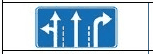
the number of lanes and the permitted directions of travel for each of them
5.15.2 "Direction of travel for a lane"

the permitted directions of travel for the lane
5.15.3 "Beginning of a lane"
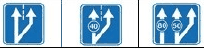
The beginning of a deceleration lane or an additional lane on an uphill gradient. If sign 4.6 "Minimum speed limit" is depicted on this sign installed before an additional lane, drivers of vehicles that cannot continue moving in the main lane at the speed indicated on the sign or higher must move into the additional lane.
5.15.4 "Beginning of a lane"
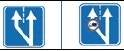
the beginning of a section of the middle lane of a three-lane road intended for movement in the given direction. If a sign prohibiting the movement of some type of vehicle is depicted on sign 5.15.4, the movement of those vehicles in the corresponding lanes is prohibited
5.15.5 "End of a lane"

the end of an acceleration lane or an additional lane on an uphill section
5.15.6 "End of a lane"

the end of the section of the middle lane of a three-lane road intended for movement in the given direction
5.15.7 "Direction of travel by lane"

if a sign prohibiting the movement of some vehicle is depicted on sign 5.15.7, the movement of that vehicle in the indicated lane is prohibited. Sign 5.15.7 with the appropriate number of arrows may be used on roads with four or more lanes
5.15.8 "Number of lanes"

indicates the number of traffic lanes and the traffic regimes by lane. The driver must comply with the requirements of the signs depicted on the arrows
5.16 "Bus and (or) trolleybus stop"

5.17 "Tram stop"

5.18 "Taxi stand"

5.19.1 "Pedestrian crossing"

in the absence of marking 1.14.1–1.14.2 at the crossing, sign 5.19.1 is installed to the left of the road, on the far boundary of the crossing, and sign 5.19.2 — to the right of the road, on the near boundary of the crossing
5.19.2 "Pedestrian crossing"

in the absence of marking 1.14.1–1.14.2 at the crossing, sign 5.19.1 is installed to the left of the road, on the far boundary of the crossing, and sign 5.19.2 — to the right of the road, on the near boundary of the crossing
5.19.3 "Diagonal pedestrian crossing"

installed at those intersections where pedestrian movement is organised diagonally across the intersection.
5.19.4 "Diagonal pedestrian crossing"

installed at those intersections where pedestrian movement is organised diagonally across the intersection.
5.20 "Artificial bump"

indicates the boundaries of an artificial bump. The sign is installed on the near boundary of the artificial bump in the direction of an approaching vehicle
5.21 "Residential zone"

a territory where the requirements of the Rules establishing the procedure for movement in a residential zone apply
5.22 "End of residential zone"

5.23.1 "Beginning of built-up area"

the beginning of a built-up area in which the requirements of the Rules establishing the procedure for movement in built-up areas apply
5.23.2 "Beginning of built-up area"

the beginning of a built-up area in which the requirements of the Rules establishing the procedure for movement in built-up areas apply
5.24.1 "End of built-up area"

the place from which, on the given road, the requirements of the Rules establishing the procedure for movement in built-up areas cease to apply
5.24.2 "End of built-up area"

the place from which, on the given road, the requirements of the Rules establishing the procedure for movement in built-up areas cease to apply
5.25 "Beginning of built-up area"

the name and beginning of a built-up area in which, on the given road, the requirements of the Rules establishing the procedure for movement in built-up areas do not apply
5.26 "End of built-up area"

the end of a built-up area marked with sign 5.25
5.27 "Zone with parking restriction"

the place from which a territory (section of road) begins where parking is prohibited
5.28 "End of zone with parking restriction"

5.29 "Regulated parking zone"

the place from which a territory (section of road) with permitted parking regulated by plates and markings begins
5.30 "End of regulated parking zone"

5.31 "Zone with maximum speed limit"

the place from which a territory (section of road) with a maximum speed limit begins
5.32 "End of zone with maximum speed limit"

5.33 "Pedestrian zone"

the place from which a territory (section of road) intended only for pedestrian movement begins
5.34 "End of pedestrian zone"

Note Signs 5.15.1 and 5.15.2 permitting a left turn from the leftmost lane also permit a U-turn from that lane. The effect of signs 5.15.1 and 5.15.2 does not extend to public transport vehicles. The zone of effect of signs 5.15.1 and 5.15.2 installed before an intersection extends to the whole intersection, unless other signs 5.15.1 or 5.15.2 installed there give different instructions.
Note The arrows indicating the direction of travel depicted on signs 5.15.1–5.15.7 may also have other configurations (shapes).
6. Information Signs
Information signs provide information about the location of built-up areas and other facilities, as well as about established or recommended traffic regimes.
6.1 "General maximum speed limit"
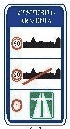
the general maximum speed limit established by the Rules
6.2 "Recommended speed"

the speed preferable for movement on the given section of road. The zone of effect of the sign extends to the nearest intersection; however, if this sign is used together with a warning sign, the zone of effect is determined by the length of the dangerous section
6.3.1 "Place for a U-turn"

a left turn is prohibited
6.3.2 "U-turn zone"

the length of the U-turn zone. A left turn is prohibited
6.4 "Parking place"

6.5 "Emergency stopping lane"

an emergency stopping lane on a steep descent
6.6 "Underground pedestrian crossing"

6.7 "Overhead pedestrian crossing"

6.8.1 "Dead end"

a road with no through passage
6.8.2 "Dead end"

a road with no through passage
6.8.3 "Dead end"

a road with no through passage
6.9.1 "Advance direction indicator"
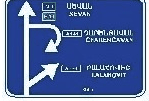
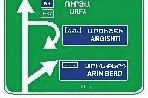

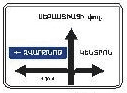
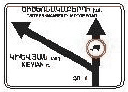
the directions of travel to the built-up areas and other facilities indicated on the sign. These signs may depict sign 6.14.1, the symbols of a motorway, an airport, and other pictograms. Sign 6.9.1 may depict images of other signs informing about features of traffic. The lower part of sign 6.9.1 indicates the distance from the place where the sign is installed to the intersection or the beginning of the deceleration lane. Sign 6.9.1 is also used to provide information about the direction for bypassing a section of road equipped with any of the prohibitory signs 3.11–3.15
6.9.2 "Advance direction indicator"


the directions of travel to the built-up areas and other facilities indicated on the sign. These signs may depict sign 6.14.1, the symbols of a motorway, an airport, and other pictograms. Sign 6.9.1 may depict images of other signs informing about features of traffic. The lower part of sign 6.9.1 indicates the distance from the place where the sign is installed to the intersection or the beginning of the deceleration lane. Sign 6.9.1 is also used to provide information about the direction for bypassing a section of road equipped with any of the prohibitory signs 3.11–3.15
6.9.3 "Traffic scheme"

the route of travel where certain manoeuvres at an intersection are prohibited, or the permitted directions of travel at a complex intersection
6.10.1 "Direction indicator"
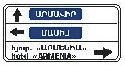
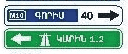

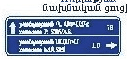
the directions of travel to the points along the route. The signs may indicate the distances to these facilities (km) and depict the symbols of a motorway, an airport, and other pictograms
6.10.2 "Direction indicator"


the directions of travel to the points along the route. The signs may indicate the distances to these facilities (km) and depict the symbols of a motorway, an airport, and other pictograms
6.11 "Name of a facility"


the name of a facility other than built-up areas (river, lake, mountain pass, point of interest, etc.)
6.12 "Distance indicator"


the distance to the built-up areas located along the route (km)
6.13 "Kilometre sign"

the distance to the beginning or end of the road (km)
6.14.1 "Route number"


6.14.1 — the number assigned to the road (route), 6.14.2 — the number and direction of the road (route)
6.14.2 "Route number"


6.14.1 — the number assigned to the road (route), 6.14.2 — the number and direction of the road (route)
6.15.1 "Direction of travel for goods vehicles"

the recommended direction of travel for goods vehicles, tractors, and self-propelled machines if their movement at the intersection in some direction is prohibited
6.15.2 "Direction of travel for goods vehicles"

the recommended direction of travel for goods vehicles, tractors, and self-propelled machines if their movement at the intersection in some direction is prohibited
6.15.3 "Direction of travel for goods vehicles"

the recommended direction of travel for goods vehicles, tractors, and self-propelled machines if their movement at the intersection in some direction is prohibited
6.16 "Stop line"

the place where vehicles must stop at a prohibitory signal of the traffic light (traffic controller)
6.17 "Bypass scheme"

the route for bypassing a section of road temporarily closed to traffic
6.18.1 "Direction of bypass"

the direction for bypassing a section of road temporarily closed to traffic
6.18.2 "Direction of bypass"

the direction for bypassing a section of road temporarily closed to traffic
6.18.3 "Direction of bypass"

the direction for bypassing a section of road temporarily closed to traffic
6.19.1 "Advance indicator of changeover to another carriageway"

the direction of travel for bypassing a section of carriageway closed to traffic on a road with a central reservation, or for returning to the right-hand carriageway
6.19.2 "Advance indicator of changeover to another carriageway"

the direction of travel for bypassing a section of carriageway closed to traffic on a road with a central reservation, or for returning to the right-hand carriageway
6.20.1 "Emergency exit"

indicates the place in a tunnel where an emergency exit is located
6.20.2 "Emergency exit"

indicates the place in a tunnel where an emergency exit is located
6.21.1 "Direction of travel to the emergency exit"

indicates the direction to the emergency exit and the distance to it
6.21.2 "Direction of travel to the emergency exit"

indicates the direction to the emergency exit and the distance to it
Note A green or blue background of signs 6.9.1, 6.9.2, 6.10.1, and 6.10.2 installed outside a built-up area means that movement to the indicated built-up area or facility takes place by motorway or another road, respectively.
Note A green or blue background inset of signs 6.9.1, 6.9.2, 6.10.1, and 6.10.2 installed within built-up areas means that, after leaving the given built-up area, movement to the built-up area or facility indicated on the signs will take place by motorway or another road, respectively, while a white background of the sign means that the indicated facility is located within the given built-up area.
7. Service Signs
Service signs provide information about the location of the corresponding facilities. They include
7.1 "First aid station"

7.2 "Hospital"

7.3 "Filling station"

7.4 "Vehicle maintenance"

7.5 "Car wash"

7.6 "Telephone"

7.7 "Catering facility"

7.8 "Drinking water"

7.9 "Hotel or motel"

7.10 "Camping site"

7.11 "Rest area"

7.12 "Road patrol service post of the traffic police"

7.13 "Police"

7.14 "International road transport control point"

7.15 "Coverage area of a radio station broadcasting traffic information"

a section of road where it is possible to receive broadcasts on the frequency indicated on the sign
7.16 "Radio communication zone with emergency services"

a section of road where a radio communication system with emergency services operates on the civilian frequency indicated on the sign
7.17 "Swimming pool or beach"

7.18 "Toilet"

7.19 "Emergency telephone"

indicates the place where a telephone for contacting operational services is located
7.20 "Fire extinguisher"

indicates the place where a fire extinguisher is located
7.21 "Filling station with electric vehicle charging capability"

8. Additional Information Signs (Plates)
Additional information signs (plates) clarify or limit the effect of the signs with which they are used. They include
8.1.1 "Distance to the object"

indicates the distance from the sign to the start of the dangerous section, the place where the corresponding restriction is introduced, or a specific object (place) located ahead in the direction of travel
8.1.2 "Distance to the object"

Indicates the distance from sign 2.4 "Give way" to an intersection when sign 2.5 "Stop" is installed directly before the intersection.
8.1.3 "Distance to the object"

indicates the distance to an object located to the side of the road
8.1.4 "Distance to the object"

indicates the distance to an object located to the side of the road
8.2.1 "Zone of effect"

indicates the length of the dangerous section of road marked by warning signs, or the zone of effect of prohibitory and information-direction signs
8.2.2 "Zone of effect"

the plates indicate and (or) provide information about
8.2.3 "Zone of effect"

the plates indicate and (or) provide information about
8.2.4 "Zone of effect"

the plates indicate and (or) provide information about
8.2.5 "Zone of effect"

the plates indicate and (or) provide information about
8.2.6 "Zone of effect"

the plates indicate and (or) provide information about
8.3.1 "Directions of effect"

indicate the directions of effect of signs installed before an intersection, or the directions of travel to objects located directly by the road
8.3.2 "Directions of effect"

indicate the directions of effect of signs installed before an intersection, or the directions of travel to objects located directly by the road
8.3.3 "Directions of effect"

indicate the directions of effect of signs installed before an intersection, or the directions of travel to objects located directly by the road
8.4.1 "Type of vehicle"

indicates the type of vehicle to which the effect of the sign extends. The effect of signs used with these plates extends
8.4.2 "Type of vehicle"

indicates the type of vehicle to which the effect of the sign extends. The effect of signs used with these plates extends
8.4.3 "Type of vehicle"

indicates the type of vehicle to which the effect of the sign extends. The effect of signs used with these plates extends
8.4.4 "Type of vehicle"

indicates the type of vehicle to which the effect of the sign extends. The effect of signs used with these plates extends
8.4.5 "Type of vehicle"

indicates the type of vehicle to which the effect of the sign extends. The effect of signs used with these plates extends
8.4.6 "Type of vehicle"

indicates the type of vehicle to which the effect of the sign extends. The effect of signs used with these plates extends
8.4.7 "Type of vehicle"

indicates the type of vehicle to which the effect of the sign extends. The effect of signs used with these plates extends
8.4.8 "Type of vehicle"

indicates the type of vehicle to which the effect of the sign extends. The effect of signs used with these plates extends
8.4.9 "Except type of vehicle"

indicate the type of vehicle to which the effect of the sign does not extend. Plate 8.4.14 indicates that the effect of the sign does not extend to vehicles used as taxi cars
8.4.10 "Except type of vehicle"

indicate the type of vehicle to which the effect of the sign does not extend. Plate 8.4.14 indicates that the effect of the sign does not extend to vehicles used as taxi cars
8.4.11 "Except type of vehicle"

indicate the type of vehicle to which the effect of the sign does not extend. Plate 8.4.14 indicates that the effect of the sign does not extend to vehicles used as taxi cars
8.4.12 "Except type of vehicle"

indicate the type of vehicle to which the effect of the sign does not extend. Plate 8.4.14 indicates that the effect of the sign does not extend to vehicles used as taxi cars
8.4.13 "Except type of vehicle"

indicate the type of vehicle to which the effect of the sign does not extend. Plate 8.4.14 indicates that the effect of the sign does not extend to vehicles used as taxi cars
8.4.14 "Except type of vehicle"

indicate the type of vehicle to which the effect of the sign does not extend. Plate 8.4.14 indicates that the effect of the sign does not extend to vehicles used as taxi cars
8.4.15 "Except type of vehicle"

indicate the type of vehicle to which the effect of the sign does not extend. Plate 8.4.14 indicates that the effect of the sign does not extend to vehicles used as taxi cars
8.5.1 "Saturdays, Sundays, and public holidays"

the plates provide information about the days of the week during which the sign is in effect
8.5.2 "Working days"

the plates provide information about the days of the week during which the sign is in effect
8.5.3 "Days of the week"

the plates provide information about the days of the week during which the sign is in effect
8.5.4 "Time of effect"

plate 8.5.4 provides information about the hours of the day, and plates 8.5.5–8.5.7 — also about the days of the week, during which the sign is in effect
8.5.5 "Time of effect"

plate 8.5.4 provides information about the hours of the day, and plates 8.5.5–8.5.7 — also about the days of the week, during which the sign is in effect
8.5.6 "Time of effect"

plate 8.5.4 provides information about the hours of the day, and plates 8.5.5–8.5.7 — also about the days of the week, during which the sign is in effect
8.5.7 "Time of effect"

plate 8.5.4 provides information about the hours of the day, and plates 8.5.5–8.5.7 — also about the days of the week, during which the sign is in effect
8.5.8 "Ice"

the plate is used with sign 4.9.1 to provide information that the effect of sign 4.9.1 applies only during the period in which the road surface is covered with snow or ice. If necessary, plate 8.5.8 may also be used with signs 1.15, 1.32, 1.33, 3.2, 3.3, 3.4, 3.5, 3.7, 3.8, 3.9, 3.10, 3.20, 3.22, 3.24, 3.32, 3.33, 5.31
8.6.1 "Method of parking the vehicle"

indicate the methods of parking vehicles
8.6.2 "Method of parking the vehicle"

indicate the methods of parking vehicles
8.6.3 "Method of parking the vehicle"

indicate the methods of parking vehicles
8.6.4 "Method of parking the vehicle"

indicate the methods of parking vehicles
8.6.5 "Method of parking the vehicle"

indicate the methods of parking vehicles
8.6.6 "Method of parking the vehicle"

indicate the methods of parking vehicles
8.6.7 "Method of parking the vehicle"

indicate the methods of parking vehicles
8.6.8 "Method of parking the vehicle"

indicate the methods of parking vehicles
8.6.9 "Method of parking the vehicle"

indicate the methods of parking vehicles
8.7 "Parking with the engine off"

Indicates that, in a parking area marked with sign 6.4 "Parking place", parking of vehicles is permitted only with the engine off.
8.8 "Paid services"

provides information that the services rendered are paid
8.9 "Limited duration of parking"

Indicates the maximum time a vehicle may remain in a parking area marked with sign 6.4 "Parking place".
8.10 "Place for vehicle inspection"

Indicates that an area marked with sign 6.4 "Parking place" or 7.11 "Rest area" has an inspection pit or another facility for inspecting a vehicle.
8.11 "Restriction on permissible maximum mass"

provides information that the effect of the sign extends only to vehicles whose permissible maximum mass is greater than that indicated on the plate
8.12 "Dangerous shoulder"

Warns that driving onto the shoulder is dangerous because repair work is being carried out. Used with sign 1.25 "Road works".
8.13 "Direction of the main road"

Indicates the direction of the main road at the intersection.
8.14 "Traffic lane"

indicates the traffic lane to which the effect of the sign or traffic light extends
8.15 "Blind pedestrians"

Indicates that blind people use the pedestrian crossing. Used with signs 1.22, 5.19.1 and 5.19.2 "Pedestrian crossing" and traffic lights.
8.16 "Wet surface"

provides information that the effect of the sign applies only during the period in which the road surface is wet
8.17 "Persons with disabilities"

Indicates that the effect of sign 6.4 "Parking place" extends only to invalid carriages and cars fitted with the "Person with a disability" identification sign.
8.18 "Except persons with disabilities"

provides information that the effect of the sign does not extend to invalid carriages and cars fitted with the "Person with a disability" identification sign
8.19 "Class of dangerous goods"

Indicates the class number or numbers of dangerous goods according to the standard.
8.20.1 "Type of vehicle bogie"

used with sign 3.12 and indicate the number of close-set axles of a vehicle, for each of which the mass indicated on the sign is considered the maximum permissible
8.20.2 "Type of vehicle bogie"

used with sign 3.12 and indicate the number of close-set axles of a vehicle, for each of which the mass indicated on the sign is considered the maximum permissible
8.21.1 "Type of public transport vehicle"

used with sign 6.4 and indicate areas intended for parking vehicles near metro stations, bus (trolleybus), or tram stops
8.21.2 "Type of public transport vehicle"

used with sign 6.4 and indicate areas intended for parking vehicles near metro stations, bus (trolleybus), or tram stops
8.21.3 "Type of public transport vehicle"

used with sign 6.4 and indicate areas intended for parking vehicles near metro stations, bus (trolleybus), or tram stops
8.22.1 "Obstacle"

used with signs 4.2.1–4.2.3 and indicate an obstacle and the direction for bypassing it
8.22.2 "Obstacle"

used with signs 4.2.1–4.2.3 and indicate an obstacle and the direction for bypassing it
8.22.3 "Obstacle"

used with signs 4.2.1–4.2.3 and indicate an obstacle and the direction for bypassing it
8.23 "Tow truck operating"

indicates that, within the zone of effect of signs 3.27–3.30, vehicle towing is carried out
8.24 "Parking for service vehicles"

the plate may indicate the name of the organisation using the parking area
8.25 "Except service vehicles"

the plate may indicate the name of the organisation
8.26 "Parking for tourist buses"

8.27 "Except tourist buses"

8.28 "Parking for vehicles carrying out mobile trade"

8.29 "Electric vehicle charging"

used with signs 7.4, 7.5, 7.7, 7.9–7.11 to provide information about the possibility of charging electric vehicles
Note "Zone of effect" plates indicate: 1) 8.2.2 — the zone of effect of prohibitory signs 3.27 "No stopping", 3.28 "No parking", 3.29 "No parking on odd-numbered days of the month" and 3.30 "No parking on even-numbered days of the month";
Note 2) 8.2.3 — the end of the zone of effect of signs 3.27–3.30;
Note 3) 8.2.4 — that the vehicle is within the zone of effect of signs 3.27–3.30;
Note 4) 8.2.5 and 8.2.6 — the direction and zone of effect of signs 3.27–3.30 where stopping or parking is prohibited along one side of a square, a building frontage or similar places.
Note The effect of signs used with "Type of vehicle" plates extends: 1) with plate 8.4.1 — to goods vehicles with a permissible maximum mass exceeding 3.5 tonnes, including those operated with a trailer;
Note 1.1) with plate 8.4.2 — to goods vehicles of any type and tractors, when operated with a trailer or semi-trailer, and to vehicles towing motor vehicles;
Note 2) with plate 8.4.3 — to passenger cars and goods vehicles with a permissible maximum mass of up to 3.5 tonnes;
Note 2.1) with plate 8.4.3.1 — to electric and hybrid vehicles that can be charged from an external power source;
Note 3) with plate 8.4.8 — to vehicles fitted with the "Dangerous goods" identification sign.
Note Plate 8.4.14 indicates that the effect of the sign does not extend to vehicles used as taxi cars.
Note "Method of parking" plates indicate how vehicles are to be parked: 1) 8.6.1 — on the carriageway along the footway, for all vehicles;
Note 2) 8.6.2–8.6.9 — in a parking area beside the footway, for passenger cars and motorcycles.
Note Plate 8.19 is used with signs 3.32 "No vehicles carrying dangerous goods" and 4.8.1–4.8.3 "Direction of travel for vehicles carrying dangerous goods".
Note Plates are installed directly beneath the signs with which they are used. If the signs are installed over the carriageway, shoulder, or footway, then plates 8.2.2–8.2.4 and 8.13 may be installed to the side of the sign.
Note Added 08.05.25.
Road Markings (Form No. 2)
I. Horizontal Markings
1.1

a solid line that separates traffic flows of opposite directions (centre line), marks the boundaries of traffic lanes in dangerous places on the road, indicates the boundaries of the carriageway onto which entry is prohibited, and indicates the boundaries of vehicle parking places.
1.2

a solid line (edge line) that indicates the edge of the carriageway and the central reservation.
1.3

on roads with four or more traffic lanes, separates traffic flows of opposite directions (centre lines).
1.4

a yellow solid line that indicates places where stopping and parking are prohibited. Used independently or with sign 3.27 "No stopping" and applied at the edge of the carriageway (where an edge line is present — instead of it) or along the top of the kerb.
1.5

a broken line that separates traffic flows of opposite directions on roads with two or three traffic lanes (centre line), and on roads with two or more lanes in one direction indicates the boundaries of traffic lanes.
1.6

"approach line" — a broken line that warns of an approach to marking 1.1 or 1.11 separating traffic flows of opposing or like directions (the length of each stroke is three times the distance between these strokes).
1.7

a broken line that marks traffic lanes within an intersection (the length of the strokes and the distance between them are equal).
1.8

a wide broken line that marks the boundary between the main lane of the carriageway and an acceleration or deceleration lane.
1.9

a broken (reversible) line that marks the boundaries of traffic lanes on which reversible regulation is carried out, and, when the reversible traffic lights are switched off, separates traffic flows of opposite directions.
1.10

a yellow broken line that indicates places where parking is prohibited. Used independently or with sign 3.28 "No parking" and applied at the edge of the carriageway (where an edge line is present — instead of it) or along the top of the kerb.
1.11

a combination of a solid line and a broken line, which: separate traffic flows of opposite or like directions on sections of road where changing lanes is permitted only from one lane; indicate places for U-turns, as well as entry onto adjoining territories, exit from them, and similar places where movement is permitted only in one direction.
1.12

"stop line" — a solid line that indicates the place where the driver must stop when there is a prohibitory signal of the traffic light (traffic controller) or sign 2.5 "No entry without stopping," as well as before a railway crossing when passage through the crossing is prohibited.
1.13

indicates the place where the driver, if necessary, must stop and give way to vehicles travelling on the road being crossed.
1.14.1

"zebra" — denote a pedestrian crossing. The marking arrows (1.14.2) indicate the direction of pedestrian movement.
1.14.2
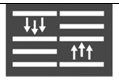
"zebra" — denote a pedestrian crossing. The marking arrows (1.14.2) indicate the direction of pedestrian movement.
1.15

broken lines that indicate the place where a cycle path crosses the carriageway.
1.16.1

denote guiding islands: in places where traffic flows of opposite directions are separated
1.16.2

denote guiding islands: in places where like traffic flows or traffic flows of a like direction are separated
1.16.3

denote guiding islands: in places where traffic flows of different directions merge.
1.17

a yellow zigzag solid line that denotes the stopping points of public transport vehicles, and, where sign 5.18 "Taxi stand" is present — taxi stands.
1.18

indicates the permitted directions of travel at an intersection by lane. Used independently or with signs 5.15.1 "Directions of travel by lane" and 5.15.2 "Direction of travel for a lane." Marking with a dead-end image indicates that turning onto the nearest carriageway is prohibited. Marking permitting a left turn from the leftmost lane also permits a U-turn.
1.19

warns of an approach: to the end of a traffic lane (to a section where the number of traffic lanes in the given direction decreases). May be used with signs 1.20.1–1.20.3 "Road narrows"; to marking 1.1 or 1.11 when they separate traffic flows of opposite directions. Used together with marking 1.6 "Approach line."
1.20

warns of an approach to marking 1.13.
1.21

the inscription "STOP" — warns of an approach to marking 1.12 when it is used with sign 2.5 "No entry without stopping."
1.22

indicates the road (route) number.
1.23


indicates a special lane intended for the movement of public transport vehicles.
1.24.1

respectively duplicate road signs 1.20.2 "Road narrows," 3.24 "Maximum speed limit," and 8.17 "Persons with disabilities," and are used together with them.
1.24.2

respectively duplicate road signs 1.20.2 "Road narrows," 3.24 "Maximum speed limit," and 8.17 "Persons with disabilities," and are used together with them.
1.24.3

respectively duplicate road signs 1.20.2 "Road narrows," 3.24 "Maximum speed limit," and 8.17 "Persons with disabilities," and are used together with them.
1.24.4
duplicates plate 8.4.3.1; used independently or with plate 8.4.3.1.
1.25

indicates artificial bumps on the carriageway, used with sign 5.20 "Artificial bump."
1.26

(colour — yellow) — denotes an intersection section, entry onto which is prohibited if a traffic jam has formed ahead in the direction of travel that would force the driver to stop, creating an obstacle to the movement of vehicles in the transverse direction along the road being crossed, except in the cases of turning right or left established by these Rules. Used independently or with sign 1.35 "Intersection section." Lines 1.1, 1.2, and 1.3 must not be crossed. Line 1.1 may be crossed when it marks the boundaries of vehicle parking places — when manoeuvring to enter or exit the parking area, and line 1.2 may be crossed to stop on the shoulder and to move off from a stopping place at places where stopping or parking of vehicles is permitted. Lines 1.5–1.8 may be crossed from either side. In the absence or when switched off of reversible traffic lights, marking 1.9 may be crossed if it is to the right of the driver, and when the reversible traffic light is on — from either side, if these lines separate lanes of like-direction traffic. When the reversible traffic light is switched off, the driver must immediately move to the right of marking 1.9. When the reversible traffic lights are switched off, crossing marking 1.9, which separates traffic flows of opposite directions, is prohibited. Line 1.11 may be crossed from the side of the broken line, and, when completing an overtaking or passing manoeuvre — also from the side of the solid line.
Note Lines 1.1, 1.2, and 1.3 must not be crossed.
Note Line 1.1 may be crossed when it marks the boundaries of vehicle parking places — when manoeuvring to enter or exit the parking area, and line 1.2 may be crossed to stop on the shoulder and to move off from a stopping place at places where stopping or parking of vehicles is permitted.
Note Lines 1.5–1.8 may be crossed from either side.
Note In the absence or when switched off of reversible traffic lights, marking 1.9 may be crossed if it is to the right of the driver, and when the reversible traffic light is on — from either side, if these lines separate lanes of like-direction traffic. When the reversible traffic light is switched off, the driver must immediately move to the right of marking 1.9.
Note When the reversible traffic lights are switched off, crossing marking 1.9, which separates traffic flows of opposite directions, is prohibited.
Note Line 1.11 may be crossed from the side of the broken line, and, when completing an overtaking or passing manoeuvre — also from the side of the solid line.
II. Vertical Markings
Denotes
2.1.1

elements of road structures (bridge and overpass supports, end parts of parapets, etc.) when they present a danger to moving vehicles.
2.1.2

elements of road structures (bridge and overpass supports, end parts of parapets, etc.) when they present a danger to moving vehicles.
2.1.3

elements of road structures (bridge and overpass supports, end parts of parapets, etc.) when they present a danger to moving vehicles.
2.2

the lower edge of the span structures of tunnels, bridges, and overpasses.
2.3

round bollards installed on central reservations and traffic islands.
2.4

guide posts, anti-ram blocks, barrier supports, etc.
2.5

the side surfaces of barriers on curves of small radius, steep descents, and other dangerous sections.
2.6

the side surfaces of road barriers on other sections.
2.7

kerbs on dangerous sections and raised traffic islands.
Vehicle Identification Signs (Form No. 3)
"Road train"
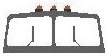
in the form of three orange lamps positioned horizontally at a distance of 150–300 mm from one another, installed on the cab roofs of goods vehicles with trailers and wheeled tractors (of class 1.4 t and above), as well as at the front part of the body roofs of articulated buses and trolleybuses.
"Speed limit"

in the form of sign 3.24 "Maximum speed limit" indicating the permitted speed (diameter — at least 160 mm, border width — 1/10 of the diameter), placed on the rear left side of the body of vehicles carrying out the organised transport of groups of children, as well as those carrying dangerous, heavy, and oversized loads, or having, according to their technical specifications, a speed lower than the speeds established by paragraphs 69 and 71 of the Rules.
"Slow-moving vehicle"

in the form of an equilateral triangle of red colour with a fluorescent coating and a reflective yellow or red border (side length — 350–365 mm, border width — 45–48 mm), placed at the rear of motor vehicles whose maximum speed set by the manufacturer is 30 km/h.
"Transport of children"

in the form of a yellow square with a red border and an image of sign 1.23 "Children" (side — at least 250 mm, border width — 1/10 of the side), placed at the front and rear parts of vehicles carrying out the organised transport of groups of children.
"Studs"

in the form of an equilateral triangle of white colour with the apex upwards, with a red border and the pictogram "ш" (side length — at least 200 mm, border width — 1/10 of the side), placed at the rear of motor vehicles with studded tyres.
"Long vehicle"

in the form of a rectangle of yellow colour with a reflective surface and a red border (dimensions — at least 1200 × 200 mm, border width — 40 mm), placed at the rear of vehicles with or without a load of more than 20 m in length, and of road trains with two or more trailers (regardless of length). If installation of a sign of such dimensions is not possible, two identical signs of at least 600 × 200 mm may be installed symmetrically about the axis of the vehicle.
"Deaf driver"

in the form of a yellow circle with an image of three small black circles at the corners of an imaginary equilateral triangle pointing downwards (sign diameter — 160 mm, small circles — 40 mm), placed at the front and rear parts of motor vehicles driven by deaf or deaf-mute drivers.
"Oversized load"

in the form of a shield with a reflective surface with diagonally alternating red and white stripes (dimensions — 400 × 400 mm, stripe width — 50 mm).
"Emergency stop"

in the form of an equilateral triangle of white colour with a reflective surface, pointing upwards, with a red border (side — 450–550 mm, border width — 40–50 mm). In the cases provided for in paragraph 23 of the Rules, this sign may also be used outside the vehicle.
"Dangerous goods"

in the form of a rectangle measuring 690 × 300 mm, placed at the front and rear parts of vehicles transporting dangerous goods; the right part, measuring 400 × 300 mm, is orange and divided lengthwise into two equal parts, and the left part is white, with a black border (width — 15 mm). Inscriptions characterising the hazardous properties of the load are made on the sign.
"Learner vehicle"

in the form of an equilateral triangle of white colour with a red border and an image of the letter "У" (U) in black (side — at least 200 mm, border width — 1/10 of the side), placed at the front and rear parts of motor vehicles used for driving instruction. A double-sided sign may be installed on the roofs of passenger cars. At the driver's discretion, the following identification signs may also be installed
"Doctor"

in the form of a square of blue colour with an inscribed white circle and an image of a red cross (side — 140 mm, circle diameter — 125 mm, cross line width — 25 mm, height — 90 mm), placed at the front and rear parts of cars driven by driver-doctors.
"Person with a disability"

in the form of a yellow square (side — 150 mm) with an image of sign 8.17 "Persons with disabilities," placed at the front and rear parts of motor vehicles driven by persons with disabilities of groups I and II, or with profound and severe functional limitation, or carrying such a person with a disability or a child with the status of a child with a disability.